No. 200 of 248 · The Natural History Series
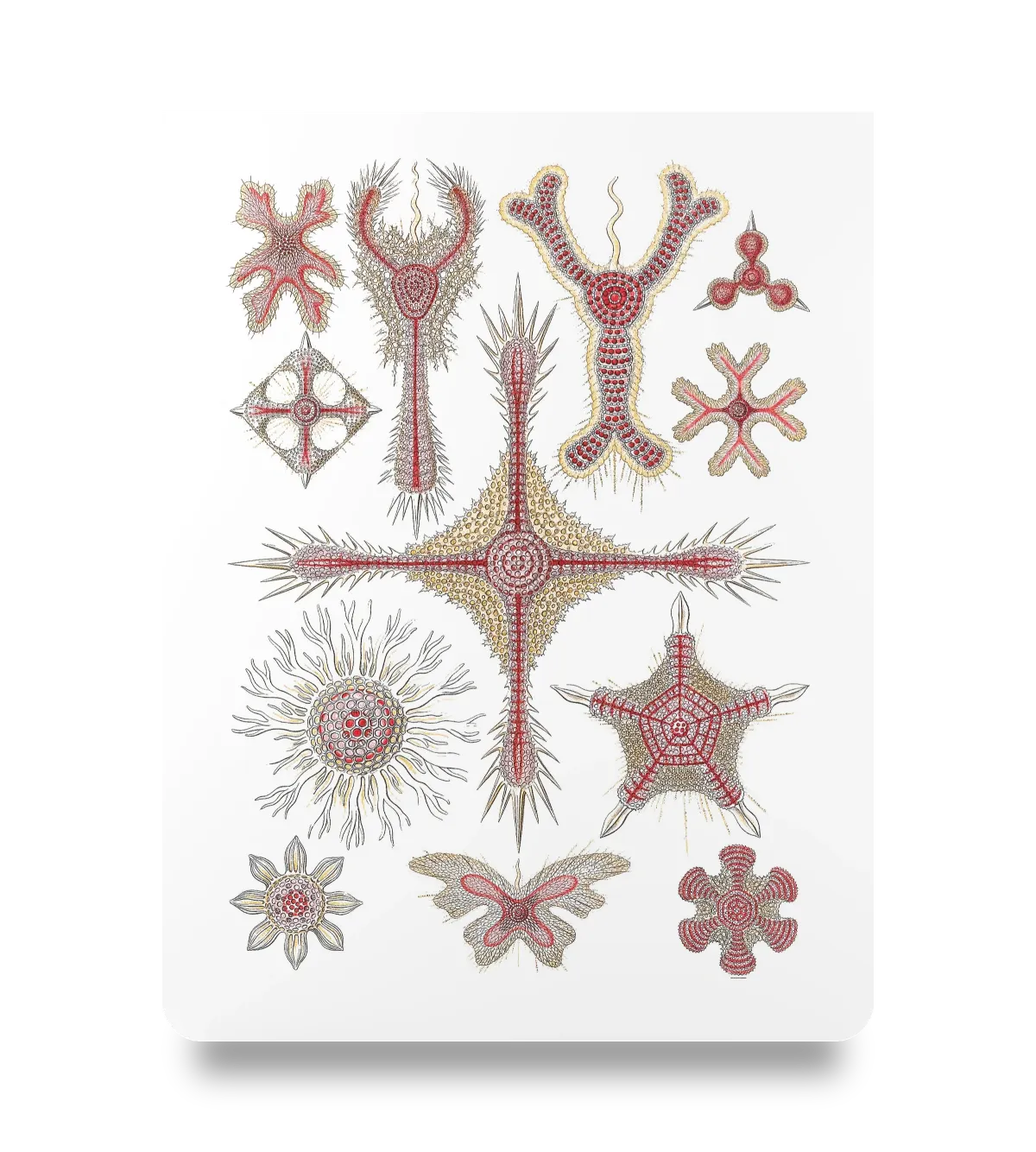
Disc Radiolarians
Pictures by Ernst Haeckel
Ernst Haeckel's disc radiolarians spread across the cover in crimson, pink and pale gold, tiny glass-skeletoned plankton drawn as stars, crosses and rosettes. Haeckel, a German zoologist, drew sea creatures as symmetrical ornament, and his plates went on to inspire Art Nouveau. For someone who loves nature, science or beautiful old prints.
Add four of your own photos and your own words; we print the card in the US and post it for you.
On the back
From the great natural-history books of the 1700s to the 1900s / DISC RADIOLARIANS / Discoidea / Radiolarians are single cells of the plankton that build skeletons of glass, smaller than a grain of sand and astonishingly symmetrical. Haeckel described thousands of them. / Kunstformen der Natur (Art Forms in Nature), 1899-1904 / Ernst Haeckel, the German zoologist, drew sea creatures as symmetrical ornament; his plates inspired Art Nouveau.
A card for
More from The Natural History Series
 Disc Jellyfishby Ernst Haeckel
 Peach, ‘Shipper’by James Marion Shull
 Mare Humorumby E. L. Trouvelot
 The Planet Marsby E. L. Trouvelot
 Head of the Great Cometby Amédée Guillemin
 Cone Shellsby G. B. Sowerby II
 Cone Shells, Thanks Dadby G. B. Sowerby II
 Cone Shells Thank Youby G. B. Sowerby II and Lovell Reeve